|
|
|
|
|
|
|
 Structured MeshTM
: Benefits over competing mesh networking architectures.
Structured MeshTM
: Benefits over competing mesh networking architectures.
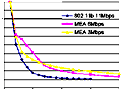
This paper analyses in detail how with merely 5
simultaneous clients per mesh node, both the single radio ad
hoc and the dual-radio, single radio mesh architectures
cannot provide usable bandwidth (for voice/video) beyond 2
hops and the implications of these limitations.
More
|
|
 |
|
MeshControlTM
: Radio and Protocol Agnostic
Software, Future Proof By Design.
Scalable software techniques mandate a level of device
abstraction - Object Oriented programming .Our Open Source
centric approach is intentionally radio &
protocol agnostic.
This accelerates product development
for our OEM source code licensees.
More
|
|
|
|
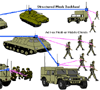
P3MTM
: Low Latency hand off even
with vehicles moving at 60 mpg.
Our mobile
multi-radio backhaul nodes were set up in a
one-mile test course along a public road, simulating a
railroad right-of-way. The automobile was driven in repeated passes
along the simulated railroad right-of-way at speeds of 55-60
mph. Throughput plot
Press Releases
|
|

|
|
EffistreamTM
: Real Time, Latency Sensitive Traffic Flow Across Network
Moving small, periodic M2M or VOIP packets through the
wireless mesh network requires special concatenation techniques to ensure
low latency and jitter performance. More |
|
|
|
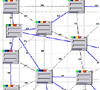
MeshSuiteTM
: Wireless Mesh Network Software
Integrated into OEM products
Leveraging our Radio and Protocol Agnostic Approach and
working closely with our OEM licensees. Meshdynamics is exploring
extensions of our scalable mesh technology to address existing challenges in IOT.
MD4000-MeshSuite
Wi-Fi-Simulation-Engine |
|

|
|
Collateral: Independent Studies
and US Government Field Test Validations
The
Battelle Institute, Naval
Postgraduate School and
US Air Force
concur: Meshdynamics provides the best throughput, latency through our
patented dynamic channel allocation, tree-based
mesh topology management and mobile network support.
Performance Analysis
|
|
|
|
|
|