|
||
 |
||
|
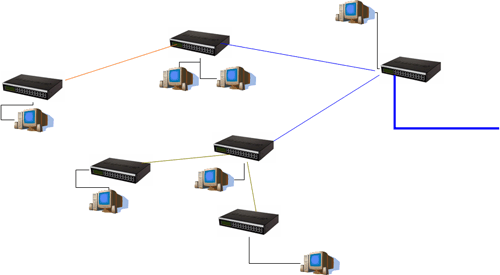
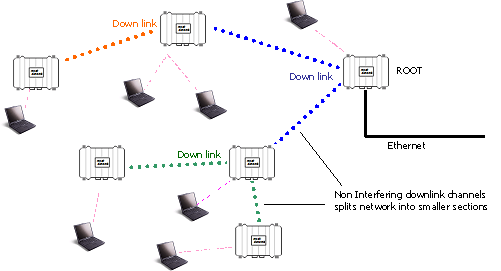
 Like wired switches, the Meshdynamics MeshControlTM software intelligence runs in each node permits it to function exactly as Layer 2 switches do. A failure of any node prompts immediate coordinated reconnections around the network to bypass the failed switch/node, see animation above. When the node is return to service, its neighbors recognize its presence and recalculate the best connections once again. This capability also makes additions and expansions to the network very straightforward, as new nodes may be simply configured with the proper security information, then powered-up. New nodes automatically are added to the network based on an exchange of information between the existing nodes, that are continually monitoring the environment. More Structured MeshTM
Is Future-Proof - supports future network growth or
new radiosEnterprise class network switches use an efficient tree structure for routing. The switch stack tree like structure uses simpler routing mechanisms - trees have no loops and complications of looping are thus eliminated. The routing table is O(n) in size. As wired network trees scales up, the wired networks scale accordingly - more switches are added to continue to segment and manage (divide and conquer) the expanding collision domains. For a broadcasting tree with depth of O(logn), the message overhead tree based routing protocols is O(nlogn). This keeps up with Moore's Law, as radio chip sets become "better". Tree based networks are future-proof. As Meshdynamics' wireless equivalent trees scale up, the dynamic channel management algorithms, running in each mesh node, change the RF radio channels, to segment and manage the shared RF mediums, also in O(nlogn). Single radio and single channel backhaul mesh networks resemble obsolete Hub Technology. These peer-to-peer networks have routing protocol overhead O(n2). Update times grow exponentially. As n increases (e.g. the network grows), Peer-to-Peer architectures eventually run out of steam. This is especially true for mobile M2M communications and rapidly changing network topology Related Links |
||
|
||